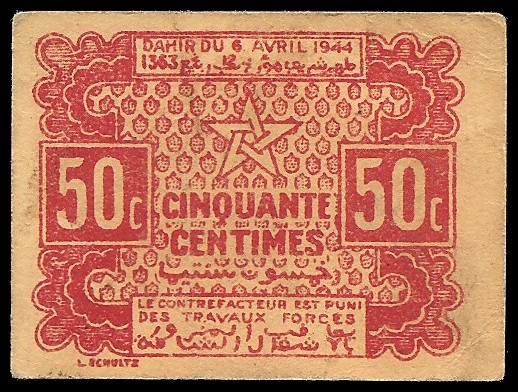
Here are three small notes, one might even call them tiny, with the smallest, the 50 centimes note, being only 31mm in height and 42mm in length, or 1.22 inches by 1.65 inches. These notes were issued in World War II under the Empire Cherifien, which refers to the Alawi dynasty dating from the 17th century until the French protectorate in 1912 was established. Coins issued during the French occupation were inscribed with the Empire Cherifien, showing that though they were a French Protectorate, the Alawi dynasty was still in place, and still reigns in Morocco today. These small notes were issued in 1944 to make up for a wartime shortage of small denomination coins which couldn’t be minted due to a wartime shortage of metal.
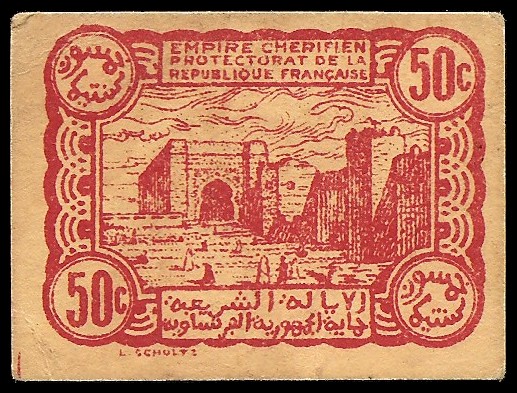
These small emergency issue banknotes were the only ones to have Empire Cherifien on them, specifically: Empire Cherifien, Protectorate de La Republique Francaise. This phrase illustrates clearly that they were both ruled by the royal family and were protected by (code for under the heavy influence of) France. This phrase was likely placed there purposefully and with careful consideration. At that particular time, after the allied invasion during Operation Torch and just two months before the D-Day invasion, there was an independence movement for Morocco, and some even signed a declaration to that effect. This, of course, did not go well with the French, who would keep hold until Morocco gained independence from France on March 2nd, 1956.
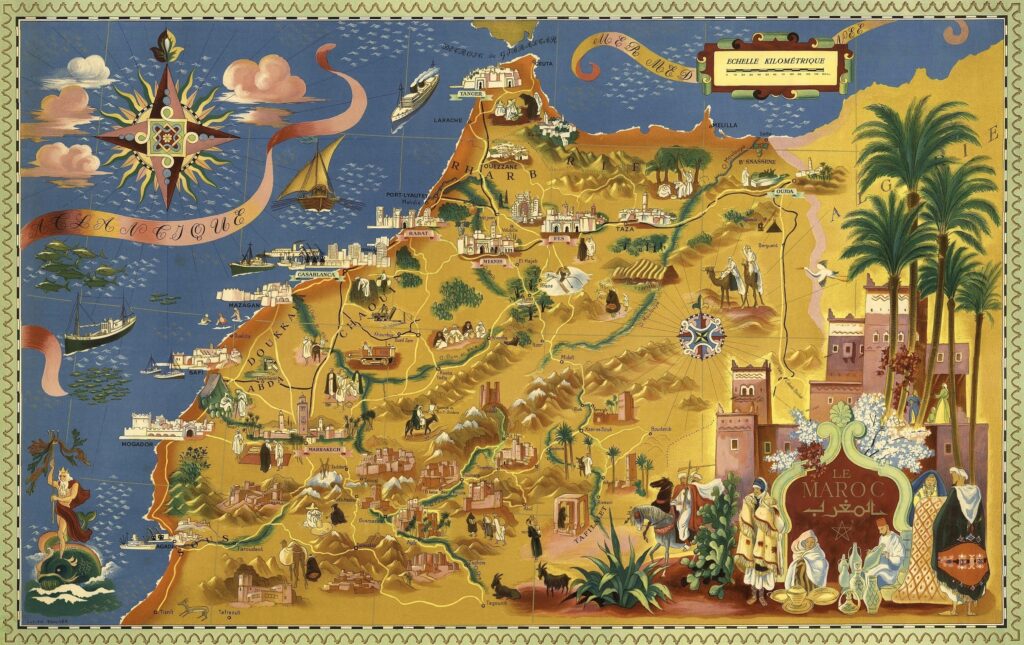
Maroc Touristique 1958 Mantel, J - Rosette
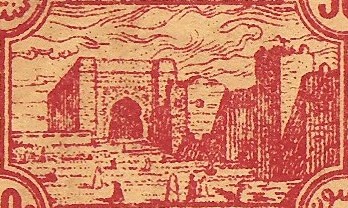
Morocco 50 Centimes - 1944 Front
Morocco 50 Centimes - 1944 Back
The 50 centimes note, red ink on white paper, has a geometric design on the front with pertinent text and denomination prominently placed. The reverse has an illustration of the main gate at the Kasbah of the Udayas along with French and Arabic text and the numeric denomination.
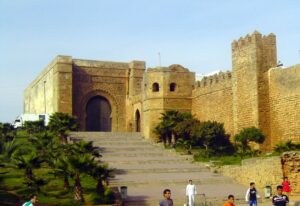
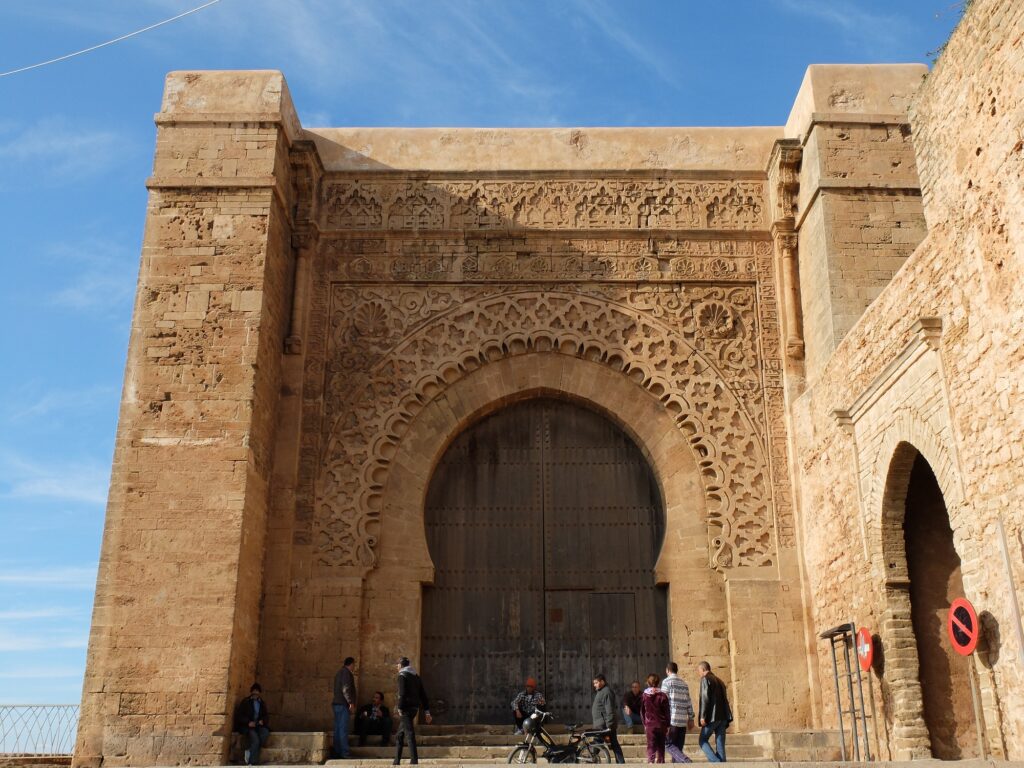
A Kasbah is a fortress. The main gate of the Kasbah of the Udayas in Rabat is called Bab Oudaia, also known as Bab al-Kbir or Bab Lakbir. It is a monumental Almohad gate built in the late 12th century, known for its beautiful architecture and intricate carvings. The Kasbah itself dates back to the 10th century when it started as a ribat, a fortified resting place or base of operations. The word ribat originally referred to voluntary defense of Islam, but in time, some ribats served as hostels along major trade routes.
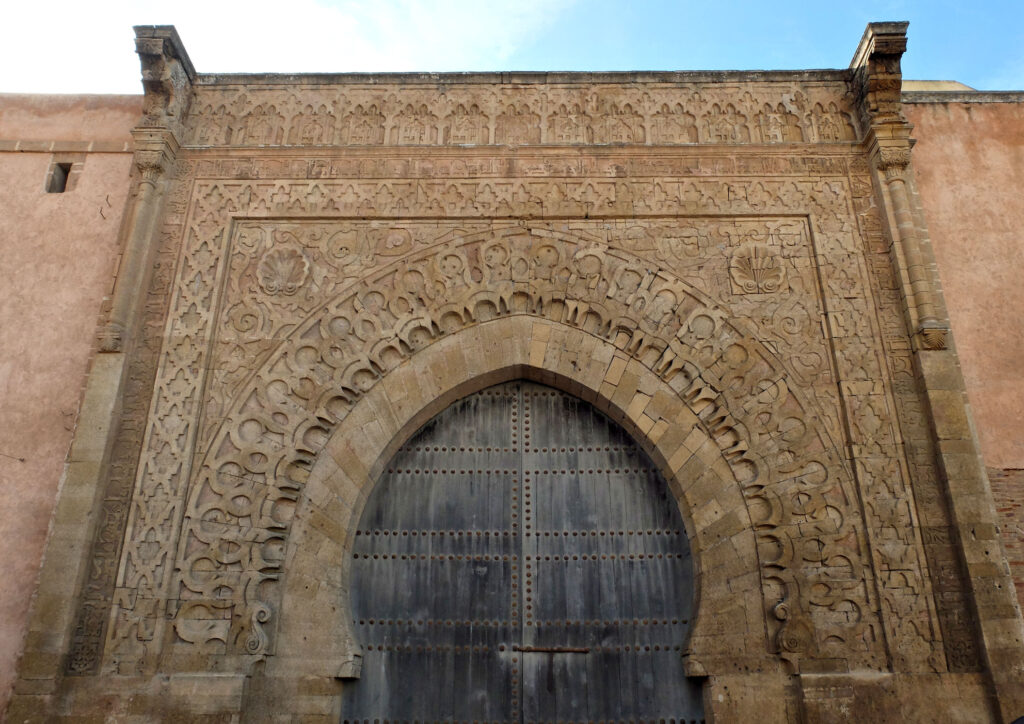
The Kasbah was associated with the Udaya tribe during the 19th century. The Udayas were expelled from Fez in 1834 after a failed revolt. A portion of the Udayas settled in the Kasbah which, at the time, was vacant. The gate is considered to be one of, if not the most, beautiful gates in Morocco, with interlacing geometric designs and outlined with Arabic verses from the Koran. The gate has three chambers inside it, creating a zig-zag passage.
Main gate with people in front.
Bab_Oudaia1 Courtesy of Robert Prazeres Wikimedia Commons
Main Gate Detail
The gate was not intended for fortification nor control of visitors, as it was installed within the Kasbah. Restoration of the Kasbah occurred in 1914 while under French occupation, and it was listed as a UNESCO (United Nations Educational, Scientific and Cultural Organization) World Heritage site in 2012.
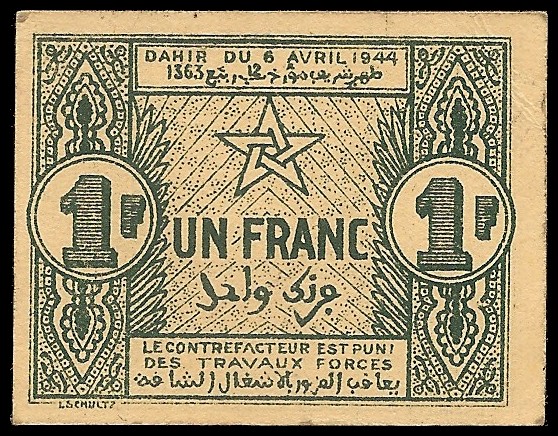
Morocco 1 Franc - 1944 Front
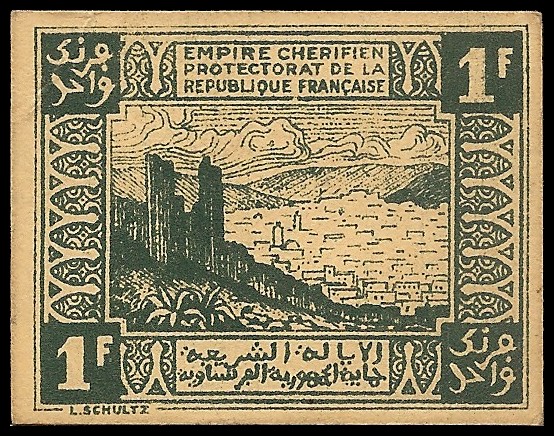
Morocco 1 Franc - 1944 Back
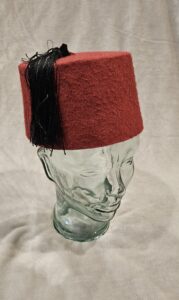
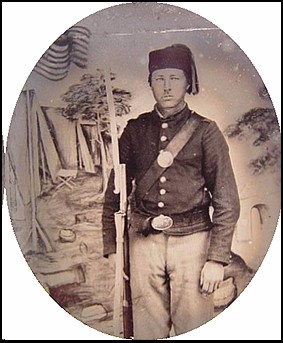
When one thinks of Morocco, one will inevitably think of Fez, and the iconic hat worn by so many over the years. In it’s historical aspect, the fez hat was worn in part as a protest of the French colonial administration. Today, it is worn by members of the Moroccan royalty and staff.
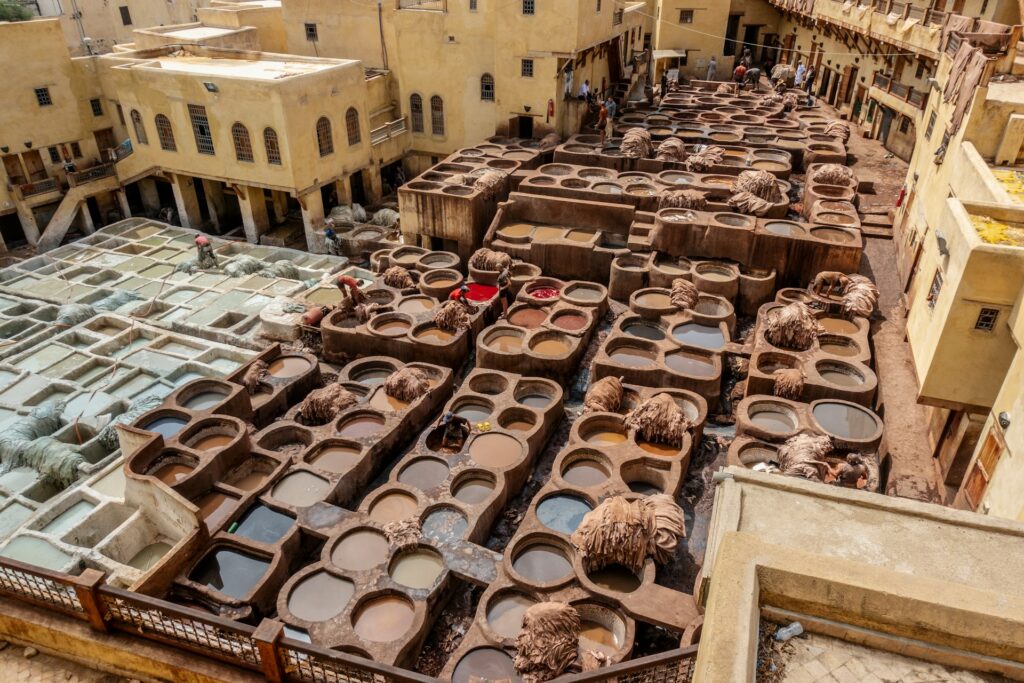
The fez is said to have had its beginnings somewhere along the Mediterranean coast, from Greece, Turkey, Tunisia, or Morocco. Though the fez was manufactured in different places, including the Austrian Empire (Czech Republic these days) it was always associated with the city of Fez, Morocco, which is famous for their dyes. The crimson coloring of the fez wasn’t always the standard color, but it soon became the standard color we all know. It’s adoption by the Ottoman Empire in Turkey made it popular during the 19th century but, after WWI, efforts were made to modernize throughout much of the region, and in many countries, the fez was not only discouraged but outlawed.
The fez hat was popular headwear for many different reasons. The Muslim, Jewish and Christian faiths all wore the fez as part of a religious garb for a while, and though it is less common today, many political persons have and still wear the fez. Historically, many military units across the globe have at one time worn a fez as part of their uniform and it has made its way into several military emblems. In the United States and United Kingdom, the fez increased in popularity in the 18th and 19th centuries, being seen as an exotic symbol of the orient, and was quickly adopted as part of many gentlemen’s leisure wear, especially used as a smoking cap along with the stylish smoking jacket that I’m sure we’ve all seen in old movies.
Zouave Soldier of the Union army
during the US Civil War with Fez
Famous Moroccan dye pots in Fez.
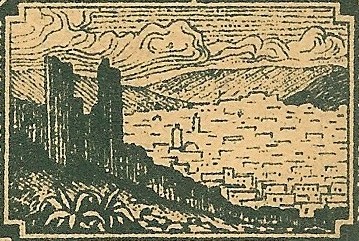
The One-Franc’s landscape of the City of Fez is seen from the hillside and is likely a scene that would be recognizable to those who had seen it at the time the note was printed. It was founded in 789AD by Idriss I, known as the ‘Father of Morocco’.
The city was located adjacent to the Wadi Fez, an important source of water for trade and travelers along the caravan road connecting the Mediterranean to Sub-Saharan Africa. His son, Idris II succeeded him in 803 and in 809 the second Idriss founded the City of al-Aliya on the far bank, across the Wadi Fez. The two cities remained separate until they were united by the Almoravid Dynasty during the 11th century.
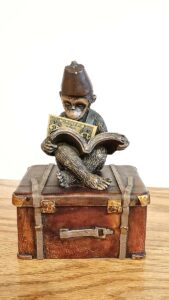
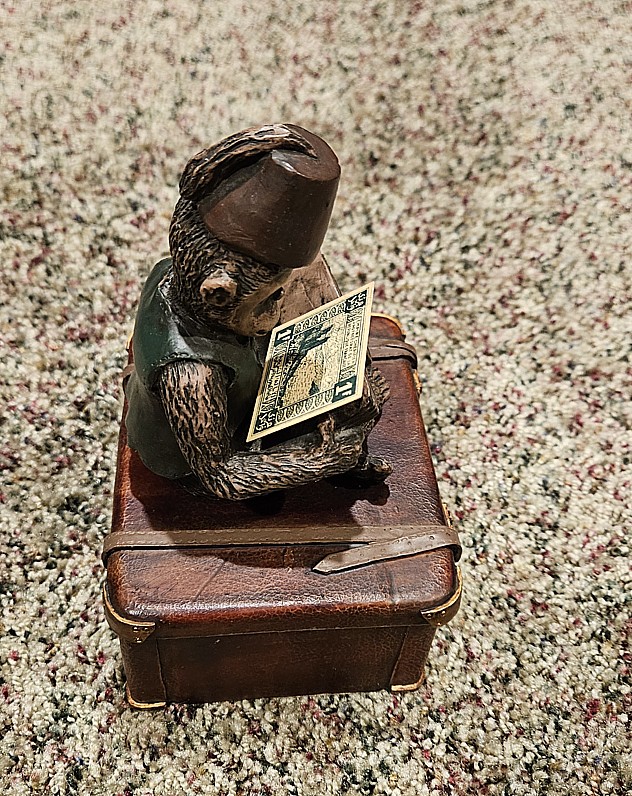
Mr. Monkey looking at the map of Fez on the small banknote.
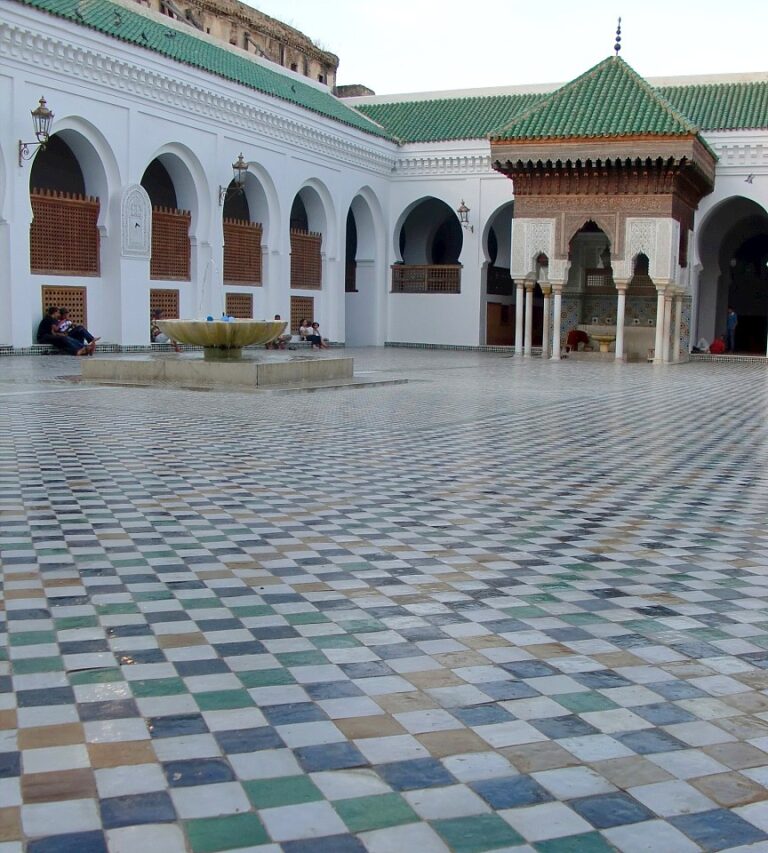
During the 9th century, Cordoba, Spain was under control of Al-Hakam I. The citizens of a suburb revolted against him, but were defeated and expelled, and many of the defeated rebels wound up settling in Fez. This happened just as settlers from Tunisia were showing up across the Wadi. This influx of people led to the city’s further development and in about 858AD a mosque called al-Qarawiyyin was built in the city and quickly became famous as not only a mosque, but as a university. Still in use, it is widely accepted that this is the oldest university in the world.
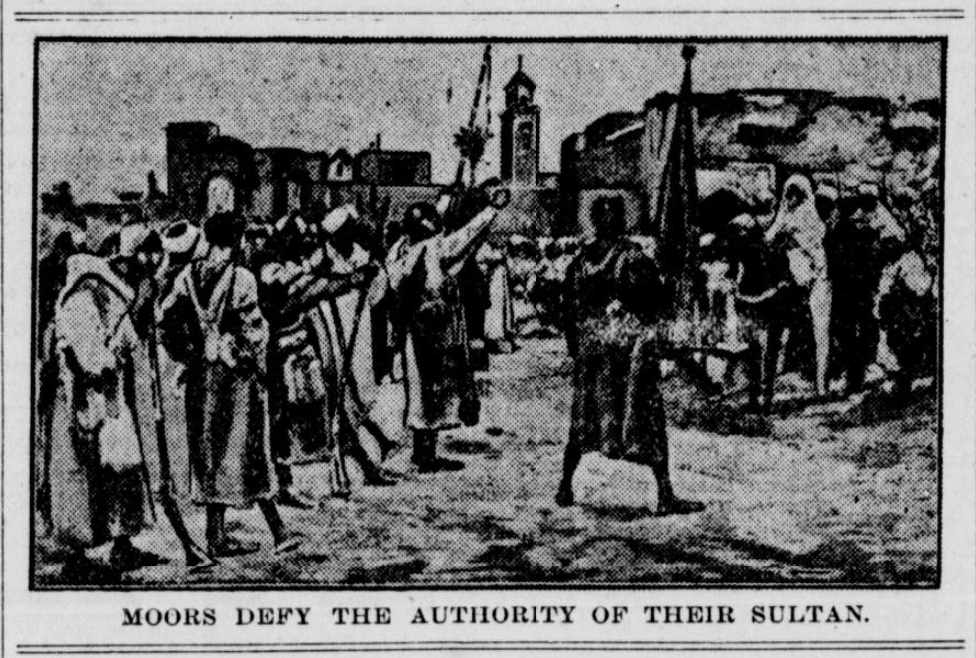
In an effort to expand their colonial power and control of North Africa, the French declared Morocco as a protectorate in 1912 with the Treaty of Fez, signed under duress by Sultan Abd al-Hafid. The treaty effectively ended Moroccan independence with France taking control of all administrative, foreign policies and military matters while leaving the Moorish government to handle matters pertaining to Moroccan and religious items. The French involvement was never popular and several attempts to remove the colonists were made, none of them successful until 1956 when Mohammed V negotiated independence from France. The Old City of Fez was declared a UNESCO World Heritage Site in 1981.
The San Juan islander. (Friday Harbor, Wash.), 05 Feb. 1903.
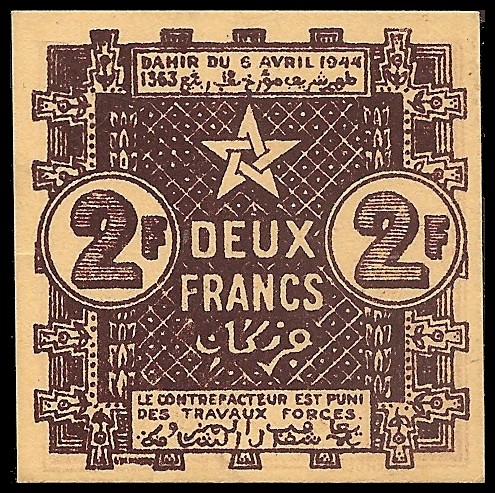
Morocco 2 Francs - 1944 Front
Morocco 2 Francs - 1944 Back
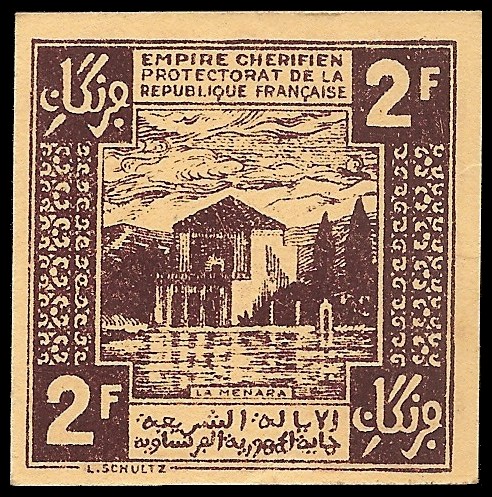
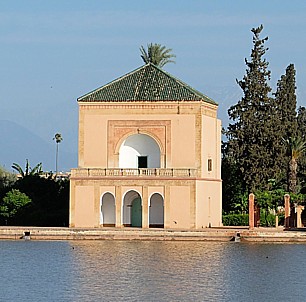
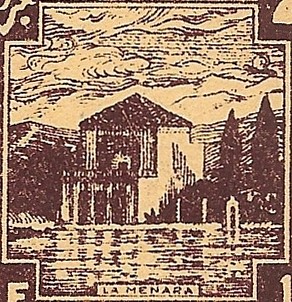
The Menara Pavillion in Marrakech is a public garden dating back to the 12th century under the reign of Abd al-Mu’min during the Almohad dynasty. The original design was to be used as an agricultural research center as well as a functioning olive orchard. The name is misleading, as the word ‘Menara’ can be translated as ‘tower’ but the root is from ‘menzeh’ which is ‘lighthouse’. There is no lighthouse there, but the word also describes the pyramidal shaped green roof of the pavilion built next to the pool, which was originally built in the 16th century. The gardens are set adjacent to a large pool which still uses the original designed hydro system some 30 kilometers (18.6 miles) away. The pool was also used to train soldiers to learn how to swim before they crossed over to Andalusia.
Modern photo of the Menara Gardens and the banknote image.
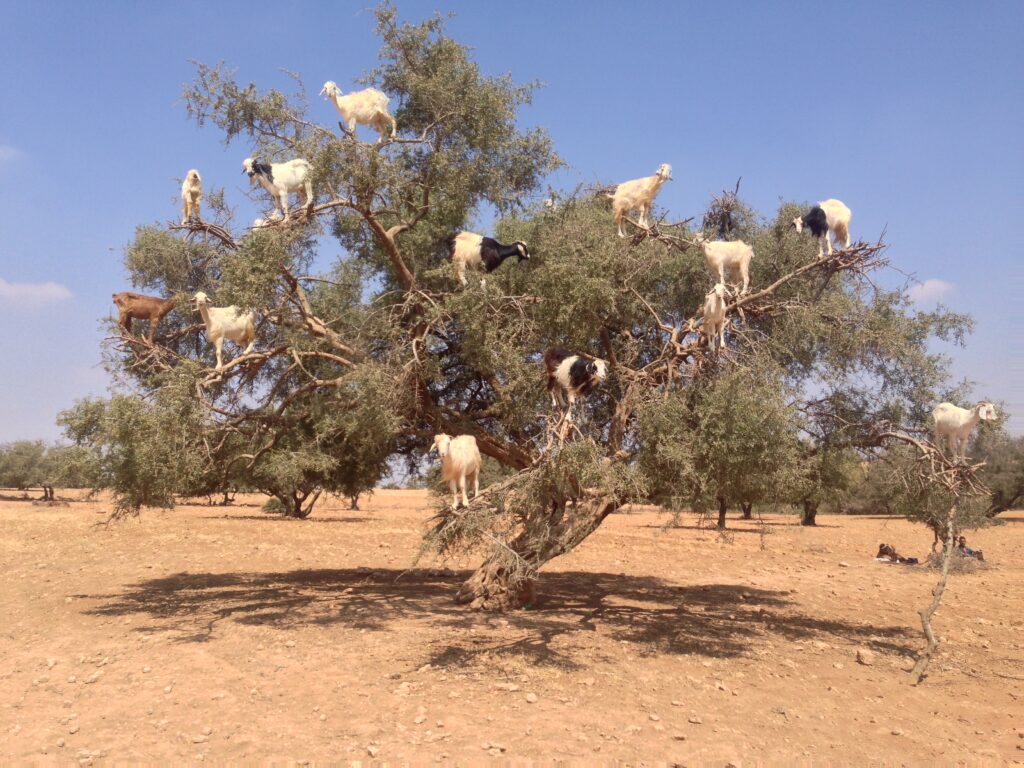
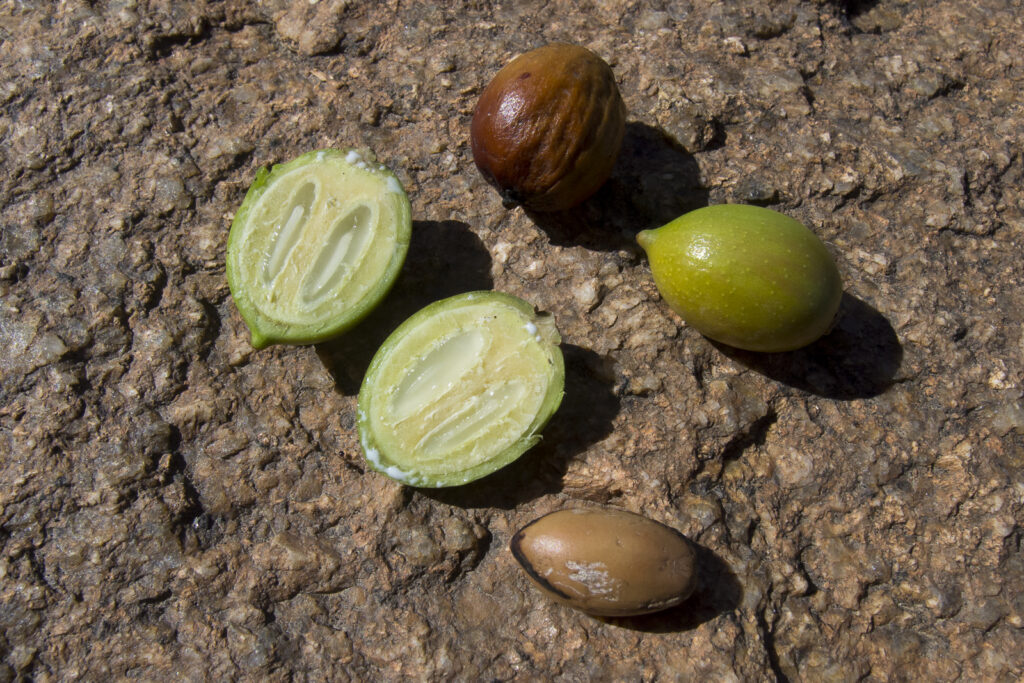
The Menara Garden is known and advertised as a quiet, serene retreat for the public and tourists and as an alternative to the hubbub of the city. The gardens are mainly argan trees, a type of nut tree which is not palpable to human taste, but the oils derived from the nuts are used in cooking as well as in the manufacture of cosmetics. Argan seeds are also used in a variety of items including animal feed. The trees are easily climbed by local goats which eat the fruit and leave the nuts. The argan tree is primarily found in southwestern Morocco. The Menara Pavillion, complete with the pool and orchard, was listed as a World Heritage Site by UNESCO in 1985.
Argan tree with goats that eat the fruit,
leaving the nuts and seeds.
Argan fruit with the seeds.
This brings us to the end. I hope you found the article interesting.