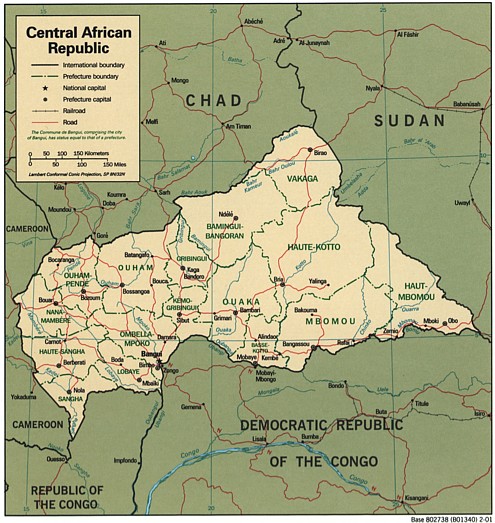
Little is known about the history of central Africa before the French began establishing settlements for its maritime service in 1839. The area was quickly colonized, and as far back as 1894, the area of the Central African Republic had French colonial administrators who created a new colony known as the Oubanougi-Shari. Sixteen years later, in 1910, Ubangi-Shari and three other territories, Gabon, Middle Congo and Chad, was included into a newer and much larger territory known as French Equatorial Africa. After WWII France had unified its government and in 1946 Ubangi-Shari, along with the other French Equatorial African colonies were granted status as territories including French citizenship for all inhabitants. In 1958 the territories voted to become autonomous republics within the French Community, and by 1960 each territory became an independent nation, and the Central African Republic (often abbreviated as C.A.R) was officially born on August 13, 1960.
David Dacko was the first president of the new nation, but as an inexperienced politician and leader, things were soon to spiral out of control. He started to consolidate power and created a one-party political system and by 1963 he won the reelection for another seven years, easily done as he was the only real candidate! Because of his inexperience, Dacko was unable to function as the leader a new country needs, caught between French loyalty and the independence movement and an association with communist China, his government was losing support of the people.
By 1965 the time for change was upon the new country and General Jean Bedel Bokassa led a coup which brought him to power. But like so many times before and since, the change was not for the better. As a spoiler for how really bad things were to become, in 1976 the country was renamed the Central African Empire, with Bokassa crowning himself Emperor Bokassa I.
Far too few African leaders learned from his story.
Central African Republic
In the early years of French influence, French Equatorial Africa (Afrique équatoriale française, or AEF) was supposedly created as a trade association for the colonies of Chad, Ubangi-Shari, Congo and Gabon. The indigenous peoples were supposed to benefit from French protection and greater trade opportunities that the French would bring to them. However, the French administration would often cause issues with the local communities by limiting their use of the land to subsistence levels only, restricting rights for those in more rural areas, removal of communities off their traditional lands, etc. This of course led to many uprisings in villages throughout the area.
One of those villages was led by Mingodon Mufasa, the father of Jean Bedel Bokassa who was born on February 22, 1921, just one of about 12 children. In 1927, his father led a resistance party which freed a handful of captives held by the French Forestiere’s, a group responsible for ensuring the French were able to have control over all the lands used for commerce. In retribution, the Forestiere’s arrested Mingodon, whose punishment was to be beaten publicly in the town square, and of which he died. Unable to cope with the loss of her husband, Bokassa’s mother committed suicide soon after. His family sent the six-year-old Bokassa to a missionary school where he excelled in sports and in the French language. Due to his proficiency with a French language workbook written by a “Jean-Bédel”, Bokassa he was given the nick name “Jean-Bédel” by his instructors. Aside from that, Bokassa’s studies were merely average, and he was not able to pursue his educational path towards the seminary, instead honed his skills in culinary arts in Brazzaville. After graduating in 1939 and enlisted in the French Colonial Forces as a light infantryman. At the onset of WWII, French Africa rallied to Free France, and Bokassa was assigned to the 2nd Battalion de Marche, where he saw action in the Syrian campaign. Bokassa was promoted to Corporal in 1940 and all the way to Sergeant Major in late 1941.
A portrait of Bokassa in 1939 probably
taken just as he was entering the military.
He changed units and eventually served in operation Dragoon, landing with the allies in France, and fighting through France and into Germany. Bokassa remained with the French military after the war, training in radio communications in France. He later went through officer training in Senegal and deployed as a communications officer in French Indo-China campaign in 1950. It was there, in 1953 that he would be awarded the Legion of Honor with the Croix de Guerre for his combat achievements. He would briefly marry, having a child in Indo-China. This marriage did not last, and he soon left his family there and returned to France where he served as an instructor for African troops in radio communications for the army.
Bokassa made his way through the ranks to being promoted to Captain in 1961 when he was assigned from the French Army to be the Commandant of the Central African Armed Forces in Bangui. With new connections to then President David Dacko, Bokassa was able to establish the Central African Republic’s army under the consolidated control of the new independent government. He was promoted in late 1964 , the country’s first Colonel.
Bokassa_portrait - National Archives Charcoal
Bokassa was now in the political arena, and he had even higher aspirations for himself in that realm. He would position himself in the company of President Dacko at ceremonies and he was always sure to present himself with his full military dress his gleaming medals prominently displayed, when he appeared in public. His tactics were obvious to those around him, and several members of Dacko’s cabinet had grown wary of Bokassa. Their consultations to the president resulted in Dacko authorizing a Gendarmerie and a Presidential Security Force designed to protect against any hostile action from within his governmental circle; This would not be enough.
Dacko’s administration was fraught with other issues as well, such as trying to settle the new administration of the government, a sluggish economy, armed factions in outlying areas, and competing political parties, especially the Movement for Social Evolution of Black Africa, and the ever-present political graft. Dacko saw a light at the end of a tunnel when the Chinese government offered him a free loan of one-billion CFA Francs. He took the money, but the economy was too far gone, and the money wasn’t enough, especially after it filtered through the political middlemen.
The moment was not missed by Bokassa, who started maneuvering himself to oust Dacko and seize control for himself. Bokassa still had people watching him closely however, and as a precaution, he was sent to Paris to serve in the Bastille Day celebrations on behalf of the Central African Republic. When Bokassa finished in Paris, he found that he was exiled by President Backo and not allowed to return. For the next three months, Bokassa sought assistance from French officials and the C.A.R. Military to convince President Dacko to reconsider his position. It took the French President, Charles de Gaulle’s insistence that Bokassa be reinstated. The French insistence could not be ignored, and Dacko was forced to allow Bokassa’s return. This was a blow to Dacko’s authority, and Bokassa, with the chasm now too deep to cross, was no longer allowed in his inner circle. Dacko took steps to ensure that only those loyal to his office would be allowed, especially military personnel. Bokassa of course knew immediately what was happening; he was being frozen out of the political sphere, where he deeply wanted to be. He allied himself with a fellow officer, Alexandre Banza, and on New Year’s Eve 1965, the coup happened. Bokassa lured the Gendarmerie chief away and had him detained. Then the military coup took Bangui and the presidential office, sending President Dacko on the run. Dacko was seized making his way westward, and he was brought back to the capital, where Bokassa compelled him to resign his position.
Bokassa immediately took to the airwaves, announcing the end of Dacko’s presidency, promising a new administration with improved economic conditions and that the threat of the communist influence from China was ended. In the meantime, he went ahead and dissolved the National Assembly and revoked the constitution.
A proud looking Bokassa wearing his medals
To help his image with the populace, he made sure that he appeared in his full military regalia wherever he went. He announced that new elections were on the horizon and that a new constitution would soon be unveiled. Bokassa promised the nation that he would rout out all the communists, fix the economy, end corruption and remove all political parties except the Movement for Social Evolution of Black Africa. To help international recognition of the new government, Bokassa insisted that the coup was necessary to remove the communist infiltrators that has come with the loan from China. He also announced that the C.A.R. would seek to remove itself from the CFA monetary zone, which is still a popular and ongoing issue in many African countries today.
New laws were instituted. Employment was mandatory for all persons between 18 and 55 years of age. Homelessness and begging were jailable offenses, and even playing traditional drums was allowed only in sanctioned performances. Some societal reforms actually seemed good, such as ending genital mutilation and wedding dowries and creating a public transit system was in the capital, Bangui. He also outlawed polygamy, though Bokassa himself would have several wives.
Bokassa’s new administration would spend a lot of money trying to honor promises to the populace and to ensure that those compatriots who sided with him for the coup were compensated. These expenses were an issue between him and his top coup assistant, Banza. When things came to a head, Bokassa had him arrested and publicly executed, a scene that would become too common.
In 1971 Bokassa was still in charge. He had promoted himself to General and declared himself as president for life. He would survive several coups attempts over the years, including an assassination attempt in early 1976. To help maintain his country and his personal spending, Bokassa needed support from outside. So instead of making a clear break from France, Bokassa made agreements to have them furnish the C.A.R. with military and financial assistance. He even re-established diplomatic ties with the Chinese government. And yet Bokassa still could not stop his spending, a pivotal move that urged him to lead his coup against Dacko.
Likening himself to Napoleon Bonaparte, Bokassa decided to declare himself Emperor and change the name of the Central African Republic to the Central African Empire. Such a grand scheme of course would need a grandiose affair to ensure everyone knew how important he was. He used the excuse that his coronation would lend credence and garner respect for the country. Bokassa would need to have the backing of France to ensure it was accepted internationally. The French government reluctantly agreed, with the stipulation that Bokassa break all ties with Libya’s Ghaddafi and that the French would still have access to the diamond and uranium mines. Bokassa’s coronation took place in 1977, with an estimated cost of $20 to $30 million U.S. Dollars, a cost that was about 1/4th to 1/3rd of the country’s annual budget. The coronation was mostly unacknowledged by foreign governments, with only 600 of the 2,500 dignitaries attending. Instead, they cast a leery eye towards Bokassa and his new empire – and rightly so.
The newly crowned emperor on his triumphant walk with his favorite wife. Though he outlawed polygamy, he still practiced it himself. According to some sources, he had 17 wives.
His throne was elaborate. A large eagle made of gold plated bronze was about $2.5 million U.S. dollars alone. His coronation attire cost another $2 million, the crown and jewels were about $5 million, and that’s not counting the cost of the 60 Mercedes Benz cars shipped in to chauffer dignitaries around the capital, nor the cost of sprucing up the city and hiring additional staff, etc.
Bokassa on his throne. Note the plastic pink castle and toy cars at his feet.
Just like Napoleon, Bokassa wanted to crown himself during his coronation, he even wore a golden laurel on his head as he entered the coronation ceremony, just like Napoleon did, and he, just like Napoleon, placed the crown atop his own head.
As Bokassa has only the laurel leaf on his head, this photo
must have been taken just before his coronation ceremony.
Bokassa’s autocracy continued, largely due to the iron fisted rule he implemented. The country was now too familiar with the executions of his political enemies, which sometimes included horrific rumors of Bokassa practicing cannibalism.
Imperial_Standard_of_Bokassa_I_(1976–1979).svg
Riots started happening, especially in the capital, Bangui. Many citizens were killed by government forces when food shortage riots took place in 1977, and France finally started to limit their financial assistance the Bokassa’s regime, which of course exacerbated the shortage issues. On one occasion when students protested against the national law for all students to wear identical uniforms, security forces again responded with violence, killing large numbers of the students.
The students did not stop protesting, and in 1979 the government arrested upwards of 100 students (though numbers vary) and imprisoned them, where they suffered violent assaults which killed large numbers of students. This action caused direct blame to be laid upon Bokassa from international governments and new agencies, which of course was denied by Bokassa. As a result, international aid to the country quickly evaporated, and it was now time for action from an ally and an enemy.
In September of 1979, the French government launched military operations to secure the airport in Bangui as a prelude to overthrow Bokassa and end his horrible reign. To help effect this, the French wanted to reinstate the old president, David Dacko, as president. Bokassa was meanwhile on an official visit to Lybia when operation Barracuda took place and the country was liberated from Bokassa’s rule. David Dacko was again proclaimed president and he the Central African Empire was returned to the Central African Republic. Bokassa remained away, seeking asylum in Libya, The Ivory Coast and eventually, and ironically, back to France.
Stupidly, Bokassa eventually returned to the Central African Republic in 1986, whereupon he was arrested and charged with a miscellany of crimes such as insurrection, murder, corruption, etc., for which he was found guilty and sentenced to death. The new president, Andre Kolingba, who himself took power from David Dacko in another coup, lightened his sentence to life imprisonment, which was then shortened to 20 years.
Bokassa was freed in 1993 and he stayed in the C.A.R. for the remainder of his life, surviving on his meager pension from the French army. His egotistic activities were still very active though; he announced that he was the 13th Apostle and that he had secret meetings with Pope John Paul II.
Bokassa passed away in 1996 from a reported heart attack. In 2010 the C.A.R. had another president, Francois Bozize, who had posthumously exonerated Bokassa, and named him as a true patriot who contributed greatly to the country. It should be noted that Bozize was an ex army officer who rose to high rank under Bokassa’s regime.
Bokassa was obviously mad with power and greed. Of this, no-one can refute. But if we look into his life experiences, we can, perhaps, see into his making. From his childhood experience of his father’s death at the hands of colonial forces and his mother’s subsequent suicide, perhaps he felt that life, or the lives of others, was not precious. His torment at school could not have helped, and the teachings of French history, including Napoleon’s rise to power may have given him the idea that such things were acceptible. His combat service in the French army may have, instead of revulsion, caused desensitization to killing and torturing. Of course, none of these experiences can serve as an excuse. Many others have had similar experiences, but few have risen to the heights of unchecked power. Instead of offering excuses and lauding his actions like Bozize did, Bokassa’s story should be a cautionary tale for all politicians. Heavy is the head that wears the crown, and how the mighty fall. He could have helped his country to achieve great things, but instead, his legacy is forever that of a tyrannical, greedy, murderous emperor, alongside Liberia’s Charles Taylor and Uganda’s Idi Amin.
Piggy Banks and scattered Money. What could go wrong?
Bokassa was prominently presented on the banknotes issued for the C.A.R titled République Centrafricaine issued under the Banque des États de l’Afrique Centrale in 1974-1976 in denominations of 500, 1000, 5000 and 10000 francsand the C.A.E. titled Empire Centrafricain issued under the Banque des États de l’Afrique Centrale from 1978-1979 in denominations of 500, 1000, 5000 and 10000 francs. The design otherwise is identical to the earlier issues. All banknotes from Central African Republic and Empire during this era are popular with collectors and are usually offered at a higher cost.
Issue from 1980-1984 have been retitled République Centrafricaine issued under the Banque des États de l’Afrique Centrale with completely different designs. The country now uses banknotes issued by the Banque des États de l’Afrique Centrale which used country code F for issues 1993-2000 and has used country code M for issues since 2000. The issues of 2022 have dispensed with code letters for member countries.