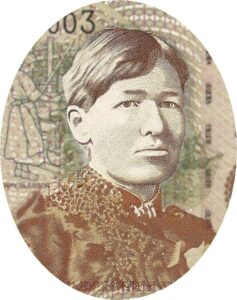
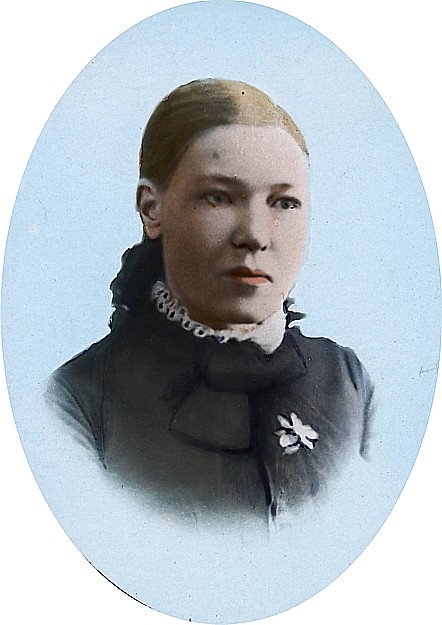
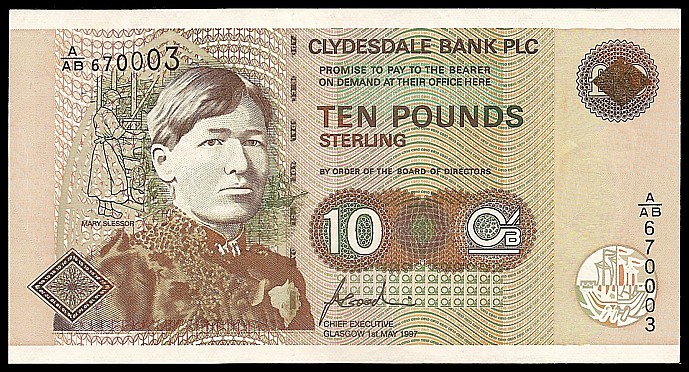
This commemorative banknote’s featured person, Mary Mitchell Slessor, was a person who spent her life for others, giving them the needed medical service and education they needed to overcome common illnesses, changing their perspectives on superstitious beliefs to save the lives of hundreds of children, bringing the Christian faith and lifestyle to what was then seen and interpreted as a ‘heathen’ people, and generally improving the lives and communities that she, a lone Victorian Age woman, saw fit to enter and be a part of. Her missionary ability outshone those of her contemporaries, usually males, and though she was seen as a bit of an outlier in her methods, they did grant her access to communities where the typical Victorian Era males were often rejected, and sometimes even killed.
Mary Slessor is a well-known Scottish missionary woman who, like David Livingstone, served most of her life as a missionary in Africa, assisting in the conversion of natives to Christianity and bringing western ideas of modern living to communities, enhancing the livelihood and saving many lives in the process.
David Livingstone was a Scottish missionary and doctor who worked in Africa. His life attained an almost legendary status as he was thought to have been lost in the African jungles until Sir Charles Stanley led an expedition which located him.
David Livingstone by Thomas Annan - Public Domain
Mary Slessor was born in 1848 to a devout Presbyterian mother and shoemaker father. Her father unfortunately was an alcoholic and would not last long in the industry, so in 1859, when Mary was 11 years old, the family had to move from Gilcomston in Aberdeen to Dundee, about 70 miles south, along Scotland east coast, where her father was able to work as a laborer. Her mother was also able to get a job in the Baxter Brother’s Jute Mill. Mary herself worked in the mills, going to a company school for half the day and then working for the mill the other half of the day. While her life in Dundee may have been an improvement to that in Gilcomston, it was not a good living by any means. The family lived in a very poor section of town, their money, even that of young Mary, unable to raise them from the slums. But Mary soon became a skilled millworker and by age 14 had ceased school to work a 12 hour shift in the factory. Life in the mills went on for several years until in 1875 Mary, and the rest of the country, heard of the death of David Livingstone, the world-famous Missionary and Doctor who spent much of his life in Africa.
Miss Mary Slessor as a girl
- Public Domain image
Mary’s mother was a devout Presbyterian who was fond of not only reading the Bible, but of their other correspondence pertaining to missions world-wide. As a result, Mary also became interested in missionary work. It is no surprise to know that the news of Livingstone’s death, that Mary was inspired and emboldened to pursue such a life for herself. Life was hard as a missionary, but Mary was no stranger to hard living, and the work would at least have meaning to it that would surpass the tedium of the harsh Scottish jute mills.
14 year old spinner in Berkshire, MA from 1916 by tender Lewis W. Hine - Public Domain-LOC
A Mill worker in 1916, similar to what Mary would have done in the mills in Dundee, Scotland.
It wasn’t long before Mary was accepted as a missionary with the Presbyterian Church. On Saturday, August 5th, 1876, now aged 28, Mary sailed from Liverpool to Duke Town on the Calabar coast. With her was a cousin, Robert M. Beedie, also a missionary. Robert started his missionary work to Calabar in 1873, and his presence and assurances would have been worth quite a lot to Mary on their month-long voyage.
Mary was told the area she would be posted was the Calabar, on the southeast edge of what is now Nigeria. Duke Town was an old slave port, but the British had enforced the ban on slave trade since 1807. That still left mental scars on the people and their distrust was hard earned. Religious beliefs of the predominant Efik people included many types of ancient and non-Christian values and superstitions were well set into the culture. Juju was a religious belief that used objects and amulets for protection and sometimes for revenge. Juju spells and incantations were very common in the area, and efforts to convert those ancient rituals into Christian beliefs was a very hard battle. There were beliefs that when a village elder died, a human sacrifice of his attendants was commonplace, done so that they could continue to serve the elder in the afterlife. Perhaps worst of all for Mary was learning that the Efik believed that when twins were born, it was a sign of bad luck, and they were either killed outright, or, more commonly, left out in the countryside to perish. Mary’s arrival was met with all that she was warned about, but perhaps her sense of adventure was enough to spur her on.
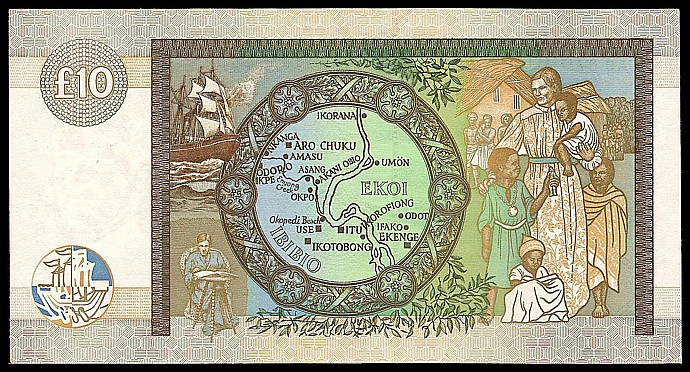
Map of the Calabar region inset on the reverse of the banknote.
Calabar Map - Century Atlas 1902
Mary spent three years in the Calabar, and was eager to trek deeper into the region, but she was suffering an attack of Malaria and could not fully recover. This may have been partly due to her lack of mosquito netting and other conveniences, as Mary was sending a sizeable portion of her salary back home to her mother and she needed to economize, living and eating much as the natives did, though she did maintain the comfort of her tea. Most likely, the malaria was contracted just as a fact of being in the African tropics. As a result of her continuing malarial fever and having also received news of her father’s passing away, she was sent back home to Scotland to recoup. 16 months later and fully recovered from her illness, Mary Slessor returned to Calabar and to the life and people she had grown to love.
Juju houses like this were common and would dispense magical potions and spells to the local people. During her time in Calabar, Mary Slessor fought attitudes towards using these, which were usually employed in revenge tactics in disputes.
Juju House in Calabar circa 1880 - Public Domain
Back among the people she was devoted to, Mary resumed her work with gusto. Mary recognized that the strict missionary protocol wasn’t as effective as a more natural relationship would be, so she adopted a much different attitude of interacting with the local people, a more casual and friendly interaction. She had been quick to learn the Efik language of the natives and spoke it with ease, which much endeared her greatly to the locals. Mary also started to live amongst the locals as well, eating the same food and living and dressing as if she belonged there, though this was partly a part of budgeting her salary, it was an effective move towards gaining trust. It has been mentioned by many of her biographers that this, as well as her affable personality, and her being a woman, that was key to her successes in her work in Calabar. Her easy personality and ease with the language gained her a number of close friends among the locals and this trustworthiness allowed her to have influence and sway opinions.
Scene of a Calabar Village from a lantern slide circa 1880 - Public Domain
With such a following, Mary was able to administer medicines and hold services preaching the gospel to large numbers of the native population. However, news arrived in Calabar that Mary’s mother and sister had both fallen ill, so in 1883, Mary once again embarked on a return trip to Scotland to visit her family. She also used this time to promote her work in Calabar, giving lectures in churches around the Dundee area.
Upon her return, Mary ventured a bit further east into the bush country, preaching Christian faith and values and promoting modern medicine and health. She had found that there were still some areas that held fast to old superstitions, including sacrificing people when an elder member passed on and, in a practice that hearkens back to the old European witch trials, making people drink poison to determine if one was guilty of a punishable crime. She also took on the challenge of changing minds about abandoning twin babies in clay pots or just leaving them in the wild to die. This horrible act stemmed from an ancient belief that jars when twins were born one of them was cursed. As it was impossible to tell which one it was, both infants were subjected to abandonment. Following her trusted methods honed from before, she found they worked just as well in the more remote areas. Many people were convinced of the flawed thinking of cursed twins and those who weren’t convinced had to face the facts when Mary would adopt some of the children she found and as they grew up, undeniably uncursed, the belief in this practice was broken. An untold number of children, many hundreds, were saved as a result of her actions. But too soon, tragedy struck at home.
It was not uncommon for Mary to find abandoned twin babies when she first got to the Calabar region. Her efforts to dispel the misconception that there was a curse on one of the twins would soon save the lives of hundreds of children.
Calabar Basket of twin babies circa 1880 -Public Domain
A new message came in 1886 bearing the news that her mother had passed in December 1885, and her sister followed, passing in March 1886. This news impacted Mary greatly, as it should. Bereft, she felt an intense loneliness knowing that her remaining family in Scotland were now gone, writing that “There is no-one to write to and tell my stories and nonsense to” and that “Heaven is now nearer to me than Britain, and no-one will worry about me if I go up country.” But Mary soon realized that she wasn’t truly alone. She had her mission and her adopted children. As many have before done in similar situations, Mary poured herself into her work.
8 Mary Slessor and her four adopted children - Public Domain
Mary did come close to marriage. She was engaged in 1891 to a fellow missionary, a teacher in Duke Town in Calabar, Charles Watt Morrison. Though 17 years younger than Mary, they were engaged but needed to obtain approval for their marriage through the Presbyterian Foreign Missionary Service. In their application to the board, Mary let it be known that she would not be willing to leave the Okoyong area, where no other missionaries were willing to go. This would require a permanent assignment for both Mary and Charles in the Okoyong. Mary’s writing mentioned that if it was God’s will, then it would happen and if not, she would be grateful for what she has. The board, however, did not approve of the application, and Mary, if not Charles, tried to be as grateful for the life she had. Charles would soon pass away just a few years later in December of 1897.
n 1894 she was responsible for the establishment of the Hope Waddell Training Institution, a school named after a previous Irish missionary who made great inroads in the Calabar region. The school was built in Glasgow of corrugated metal and Scandinavian pine and sent to Calabar. This institute instructed males in needed vocational skills including masonry, carpentry, blacksmithing, coopering (barrel making), and naval engineering, while the females were taught courses on seamstressing, domestic sciences and accounting. The school would eventually become the largest training institution in West-Africa, with stiff competitive admissions, even drawing students from neighboring countries. Though still in operation today, the Hope Waddel Institution suffered degradation and neglect after independence in 1960, but still runs primary school activities. It was updated with better access roads, renovated schoolrooms and electricity in 2005.
The Hope Waddel Institution as it appeared in 2013. Photo by Umohduke – Wikimedia Creative Commons C3.0
In 1888 May Slessor relocated to Okoyong, across the river and about 30 miles northwest of Calabar. Some missionaries had been killed there recently, and she thought that her different style may have a better effect in reaching out the people there. She was right, and found herself among the Okoyong locals for the next fifteen years.
Through Presbyterian literature and her lectures from earlier visits, her accomplishments among the Efik people, as well as her radical approach of traditional missionary methods were related to the public in Britain where she was garnered the nickname “White Queen of the Okoyong”. With suck a moniker, the press could not resist and ran articles on her, rightfully anointing her a heroine of Christian humanitarian effort in the ‘jungles of Africa” where no white male dare to tread. She was soon a famous heroine whose name made it to higher ups in the British Colonial governmental channels, who saw fit to honor her (and further use her abilities to their end) with an appointment as Vice Council and Magistrate in the Colonial Courts in the region in 1892.
Old Calabar, Nigeria: local people gathering drinking water from a river, filling vessels and washing clothes.
Public Domain Image
Mary Slessor at Ikotobong Court, Calabar, late 19th century Public Domain
While she maintained her primary missionary obligation of evangelism and promoting social change and working to bring modern education methods to the area, Mary would now be a true community leader, settling local disputes, improving not only the lives of the locals, but increasing British influence by facilitating trade and commerce. Her abilities here gained her promotion in 1905 to vice-president of the Ikot Obong Native Court. Mary’s Health had started to slowly decline. Her constant struggles in the area taking a toll on her health, she still worked tirelessly, and her service continued to be recognized in both the Calabar and in Britain. In 1913 she was awarded the Order of St John, a very honorable recognition which recognized her charitable works.
An old lantern slide image of Mary Slessor Knitting - Public Domain image
The Order of St. John.
According to St. John International, their mission is concerned with charitable service that leads globally in First Aid and medical responses to community healthcare needs.
Star - Venerable Order of St. John - Public Domain image.
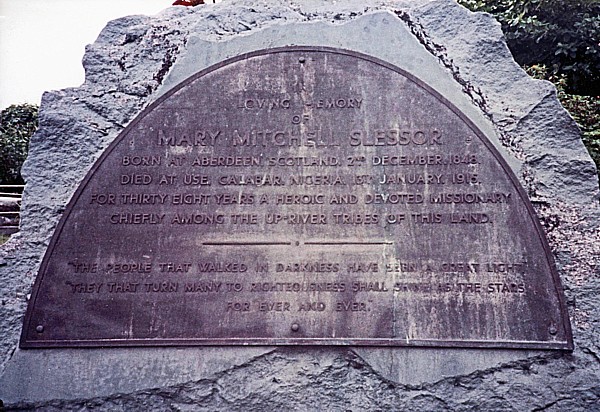
As mentioned earlier, Mary has suffered intermittent fevers from the malaria she contracted during her first missionary posting. Yet she was so devoted to her work among the Efik people in the Calabar that she pushed on, working not only with the local people and their culture, but also having to deal with the British government and the Presbyterian church’s missionary regime. The stress of the fevers and hard work started to affect her physical abilities, and she could no longer make the treks to villages miles away through the jungle. Eventually, Mary had to resort to being conveyed longer distances using a cart. Even then, the stresses were too much, and continued to wear her down. In January 1915, suffering from yet another fever, Mary Slessor, fading in and out of consciousness, was reported to have uttered the prayer: “O Abasi, sana mi yak” (O God, let me go). On January 13, 1915, Mary Mitchell Slessor, the 66-year-old “White Queen of the Okoyong”, after a life of devotion to the Calabar people and to God, she passed away.
Mary Slessor's house in Africa - Public Domain image.
Mary Slessor Grave in Calabar - Photo by RuthAS WIkimedia Commons.
A petite redheaded Scottish woman in West Africa died. While not much of a news item any day, but for Mary Slessor, the news travelled the world as if she were a head of state. Her funeral, perhaps not lavish, was still attended by officials from Britain and Nigeria, and many, many locals. Her life has been commemorated worldwide by naming school buildings and streets after her, as well as parks and a church. Even an asteroid, (like Mary, perhaps common, but not average) so large as to be classified as a minor planet (13 km or 8.1 miles in diameter) has been named after her: 4793 Slessor. But far more reaching than even the asteroid, is this banknote, issued in 1997 by the Clydesdale Bank, honoring Mary Slessor and her life’s devotion which, I’m certain for her, was more pleasure for her than all the hard work it required.
Asteroid and Dwarf Planet 4793 Slessor's position on Jan 13, 1915
Scotland 10 Pounds CB P-226a2- 1997 Front
Scotland 10 Pounds CB P-226a2- 1997 Back. The ship is the SS Ethiopia, which was the first
Ship that Mary Slessor took to Africa in 1876. Other images in this back vignette show her reading the bible and standing with her adopted children. In center is a map showing the Calabar region where she served out her days administering her missionary duties.