In 1804 the Lewis and Clark Expedition stopped and made camp just north of the modern city of Omaha, Nebraska. Just fifty years later and with treaties signed, the city of Omaha was soon planned out. In the original town plat, there were to be 320 blocks with streets 100 feet in width.
Map of Omaha City, Nebraska by Oscar F. Davis published by Gast, Moeller & Co. 1866.
The first completed house was built at 12th and Jackson streets, built by the Council Bluffs and Nebraska Ferry Company, which hosted the first residents of Omaha, William P. and Rachel Snowden. It was named the Saint Nicholas Hotel but was commonly referred to as the Claim House. As it was the first house, it was reportedly a rather crude affair, made of logs. The house was used by the Snowden’s as a boarding house for the Ferry company’s employees. The building was completed in July 1854, and on August 13, 1854, it also hosted the first religious services by the Reverend Peter Cooper. The Omaha Claim Club was quickly formed to protect the settlers in the area from claim jumpers, and they often held meetings at this location.
The town started to grow, and just one year later the first school was opened, hosting 40 students, starting on July 01, 1855, and the first photographic studio opened in Omaha in 1856. The city was officially incorporated on February 02, 1857, just three years after it was first laid out on a plat map. But that was six months after this banknote was issued.
Birds Eye View of the city of Omaha 1868 from Library of Congress
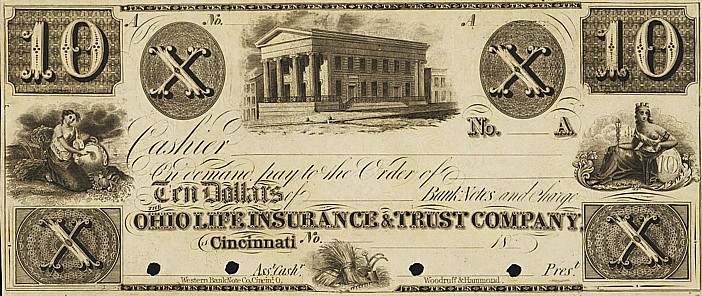
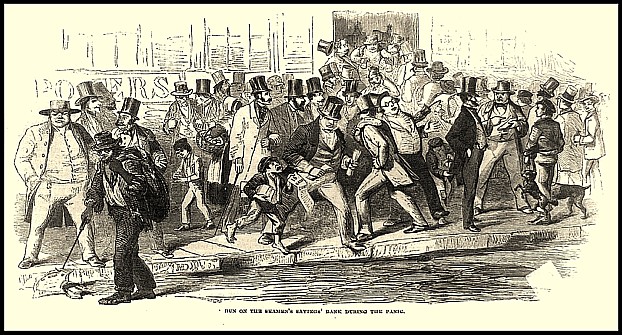
The City of Omaha was in place and growing just as the Panic of 1857 took place. Beginning on August 24, 1857, the Ohio Life Insurance and Trust Company had been suspended. It so happened that Edwin Ludlow, the Cashier of the Ohio Life Insurance and Trust Company embezzled large amounts of money to facilitate his own stock market operations and that, combined with his irresponsible lending practices, led the company into dire straits. When the news of the suspension was released, many sought to close out their accounts, but the company could not pay out the specie for the amount of the banknotes that were being turned in as they were 5 million dollars short. This was known as a “run on the bank”. When the news spread that the bank could not pay its investors and debt holders, the true panic hit. Many more people ran to all their other banks to cash in their notes, which exceeded the banks’ coffers. This news spread and multiplied across the nation.
Ohio Life Insurance and Trust Company Banknote
While the Panic of 1857 was precipitated by the failures and misconduct (including theft and inept lending practices) of Edwin Ludlow, it would be a mistake to place all of the blame on his shoulders. In fact, while Ludlow was arrested and faced charges, there were never any accounts recording any punishment received. The true nature of the collapse would have to fall on all the various banks across the nation which were also issuing massive amounts of banknotes that were far in excess of their holdings, so much so that, according to Obsolete Paper Money by Q. David Bowers, on January 01, 1857, New York city banks had $43,974,000 in liabilities, but only had specie totaling $6,557,000 to back them all. That’s over 6.71 times their liabilities. This “fractional reserve” practice was common, but the reality was that there was no set standard for banks to hold in species for their issued obligations and banknotes. Many banks had failed before and that’s why these types of banks were called “Wildcat Banks”, as they were known to be unduly risky at times. Banknotes left from these closed banks are also called “Broken Bank Notes” after these broken banks.
Political cartoon from Harper’s Weekly in October of 1857
Depicting the Run on the Seamen’s Savings Bank.
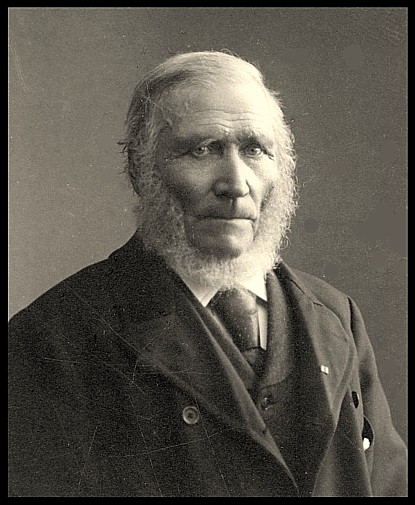
Rachel Snowden
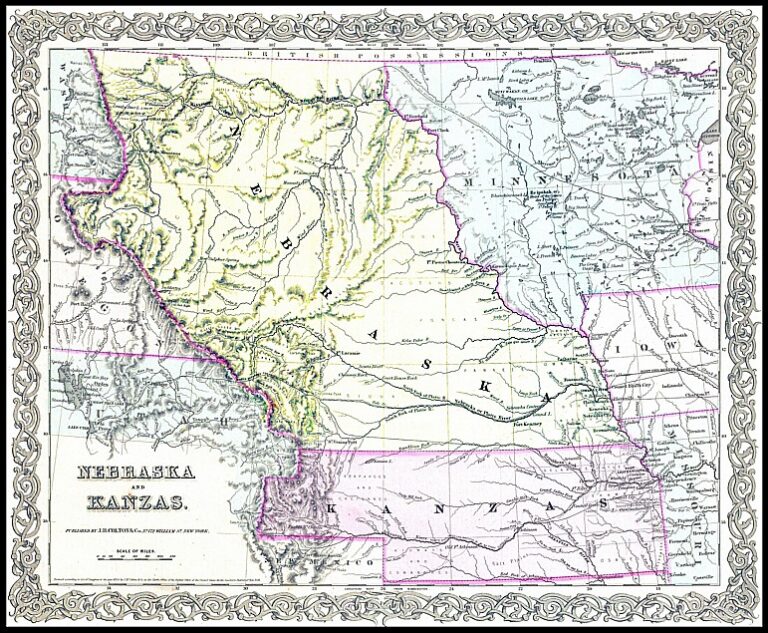
Nebraska and Kanzas (sic)1855 Colton Map
William P. Snowden
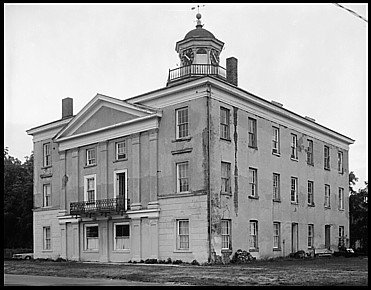
Jansonist Colony, Steeple Building, Main and Bishop Hill Streets, Bishop Hill, Henry County, IL Public Domain NPS
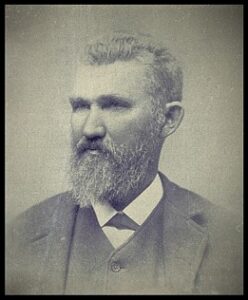
We switch over now to Illinois where there was an organization called the Bishop Hill Colony. This colony was a religious community made up of Swedish immigrants who were seeking a utopian society by living in communes on the American prairies. About 350 miles away from Omaha, Bishop Hill Colony was founded in 1846 in Illinois by Erik Jansson, a religious zealot who claimed to be a true prophet who spoke the Word of God. Jansson and his followers were so fervent in their beliefs that they eventually conducted violent uprisings, for which Jansson was arrested in 1845. He escaped, dressed as a woman, and crossed into Norway where he secluded himself until he, along with over 1,000 of his followers, sailed from Norway to the United States. A female cousin of Erik Jansson was at Bishop Hill as well, and she was married to a John Root by Jansson, but when her husband tried to leave the compound with his wife and child, he was not allowed to take them along. On May 13, 1850, Jansson was killed by John Root, who served one-year for manslaughter. After Jansson’s death, his followers waited three days, as they expected him to rise up, resurrected. Only when he remained dead for after the third day did the commune realize that they needed to continue on without him, and a committee of seven trustees was elected to run the colony.
Erik Jansson 1850
Map of Illinois by by Charles W. Morse and Charles A. Colby in 1856 shows Bishop Hill in Henry County
The panic of 1857 struck larger cities extremely hard. Many banks with large amounts of money failed, and there was no protection for their customers, who were simply left with worthless paper in their hands. Soon, the panic hit even the Nebraska Territory, and the panic took its toll on the Western Exchange Fire and Marine Insurance Company in 1857. When they closed, the company was bought by the Bishop Hill Colony in Illinois which aimed to renew the bank and issued many more banknotes with Bishop Hill Colony named as the depositor on the individual banknotes. The lessons of the Panic of 1857 were not learned, and mismanagement in investments made by one of the trustees, Olaf Johnson, the Bishop Hill version of the Western Exchange Fire and Marine Insurance Company failed, it’s banknotes once again worthless, and the colony left in ruin that would cause its final dissolution in 1861.
An unissued Bishop Hill variant of this banknote with ‘Bishop Hill Colony” printed for the depositor
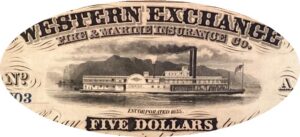
The vignette of this $5 Dollar note showcases a steamboat which proudly bears the name OMAHA on its sidewheel housing. There were a few boats named Omaha, however, not just this one. The Omaha Sidewheeler on this note is the one built in Madison, Indiana in 1856 and, though little information could be found on this vessel, it is known that it carried hardware and building materials on its maiden voyage. Its captain was Andrew Wineland and its clerk was a Mr. Wilcox.
This note, dated 1856, before the collapse of the bank and sale to Bishop Hill Colony, had quite a bit of circulation in the Omaha area. It also had a depositor who was a private citizen, though I am unable to decipher their name. The serial number was also handwritten on this note, unlike the Bishop Hill Colony note, which was stamped.
Detail of Omaha Boat Nebraska Centennial map from 1854 to 1954 showing the sidewheeler Omaha in an artistic rendering
The Omaha sidewheeler on this banknote was known as a dependable vessel. It plied the Missouri River along a 770-mile route between St. Louis, Missouri and Sioux City, Iowa for 9 years before sinking after striking ice along the river in 1865. In 1857 a Sidewheel ferry named Omaha was built, and in 1900 another steamboat was built, originally called the Lora, but was later renamed Omaha. Steamboats along the Missouri River were smaller than those along the Mississippi River but were no less equipped and as equally ornate in their furnishings.
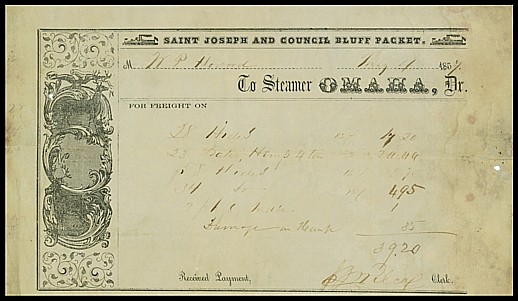
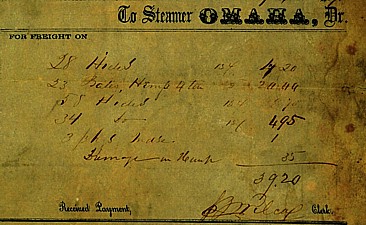
Bill of lading, steamer Omaha, for hides, bales of hemp, and packages of merchandise, May 4, 1857 - Public Domain
Enhanced Detail Bill of lading, showing clearer writing.
The name Omaha is taken from the Omaha Tribe and means “those that go against the wind and current” and is thought to have been derived from their seasonal migration along the Missouri river. It is a fitting name for any vessel, especially one who makes its way along the winding Missouri River.
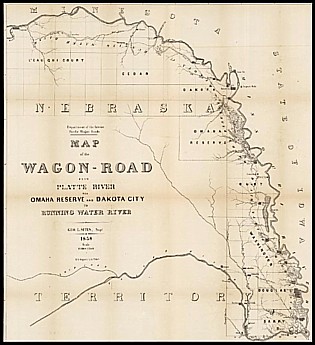
Nebraska Wagon Roads map, 1858
shows the winding Missouri River