At the end of the U.S. Civil War the State of Kansas submitted a petition to the federal government for damages incurred during the war. The petition specifically addressed actions resulting from a Confederate excursion that was known as the ‘Price Raid’, and the Union’s ‘Indian Expedition’ under General Samuel R. Curtis.
Topeka Kansas in 1867
Union General Samuel Curtis was in charge of the Department of Kansas, and was tasked to defend the western frontier during the Civil War. He was specifically sent to deal with hostile Indians, primarily Cheyenne and Lakota, who were conducting attacks on travelers through their territory. The reasons for the attacks were many, including the spread of disease, devastation of the grasses for grazing, wholesale reduction of timber, and other misuse of lands and nuisances. These attacks were effective and became disruptive to the U.S. Government and to companies transporting freight. Eventually General Curtis was made to conduct an Indian Expedition, which enlisted “friendly” Pawnees to fight against the other Indians. Curtis also enlisted what were called “Galvanized” Yankees (ex-confederate soldiers serving in the Union Army) to conduct general military operations in the area. As a result of the Indian Expedition, the affected Indians attacked more fervently, and chose additional targets, causing what was believed to be more damage than if the military had not acted at all.
In the meantime, General Curtis had a more pressing issue, similar in nature, but with a different enemy.
Fort Harker, Kansas, 1867
By 1864 the Confederate Army found itself lacking resources. In an attempt to bolster both public support for the South and to gain territory and supplies, a plan was devised to send Confederate Major-General Sterling Price into the states of Missouri and Kansas to conduct raids on the Union Military. The plan was to retake Missouri, enter Kansas and scour the land for mules, wagons and other supplies. Leaving in August 1864, Price left with 12,000 men and a small contingent of artillery. During the raids, Price and his men also killed and robbed unarmed civilians and pillaged private properties. Though these actions were not uncommon on both sides of the war, the Price Raid became infamous for its actions and was estimated to have cost over $500,000 in damages.
S. Price Sterling Price Major Gen. C. S. A.
S. R. Curtis, Major General Union Army
Lawrence, Kansas 1867
By October 1864, a mere two months after their raid started, the Confederate expedition had confiscated over 500 wagons of supplies and it seemed as if it was a success. In addition, while it was much less than he had hoped for, it is estimated that as many as 6,000 men joined up with Price while he was in Missouri. Under their long wagon train the Confederate march began to slow down, allowing the Union forces more time to act.
National Park Service Map of Price's Raid
After the Indian Expedition, General Curtis joined up with others to stop the Confederate raids. Combining militias from Kansas and Missouri with several other Federal units, the Union forces totaled somewhere around 35,000 men pursuing Price’s ever slowing force of about 18,000. Several battles ensued, following Price on his way westward. At first, as the Union forces were just assembling, Price was able to win a few skirmishes, and keep the Union Army at bay, continuing his snail’s pace.
Broadside recruiting men for the Independent Kansas Jay-Hawkers, 1st Kansas Volunteer Cavalry, August 24, 1861
11th Kansas Cavalry flag
At the battle of Westport, Missouri, Price was faced with Union soldiers in front and behind his long column. Instead of fleeing south, he decided to fight. After several hours of fighting, it became apparent that he could not win. Price then retreated back south, towing a 15 mile long wagon train of booty behind him. This line of wagons was acting as an anchor and was the undoing of the Confederate’s raid.
Westport Battle grounds in Missouri during Price's raid in the fall 1864
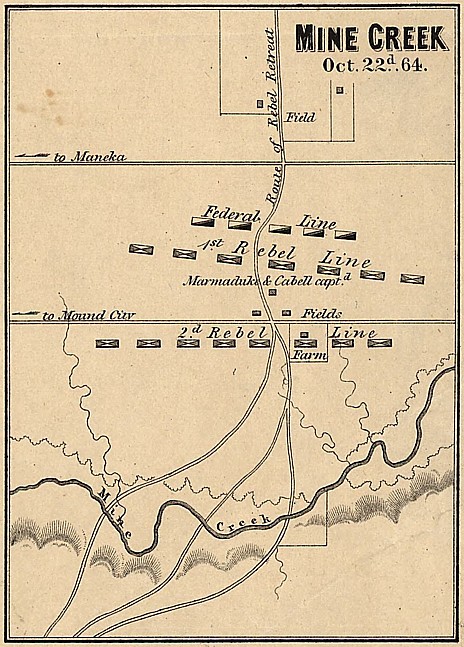
Passing through the winding Mine Creek, Price crossed a ford at the head of the line, but about halfway through, the banks softened and the wagons began to bog down, and soon were stuck hard. Price was oblivious of the situation. The Union forces in pursuit from the battle of Westport were soon upon the stranded Confederates and as the rebels were scurrying to make a stand, the Union, vastly outnumbered, but better armed with repeating rifles and pistols, started a cavalry charge. After a brief stall, the Union soldiers broke the rebel’s lines and in less than 30 minutes, the battle was over with the Union army defeating their enemy due in large part to their weaponry and to the quickness of their charge.
Mine CreekBattle grounds in Missouri during Price's raid in the fall 1864
Home-made lanternslides of the Battle at Mine Creek Kansas
Enlarged left lantern slide of Mine Creek Battle
Enlarged right lantern slide of Mine Creek Battle
Price was followed, but he decided to abandon the wagon train of loot and burn it. Thus unburdened, he found his way back south to Texas, safe and unharmed.
Watercolor painting of the Price Raid by Samuel J. Reader, 1865.
Some Union soldiers were captured during the Price Raid in Missouri and were sent to Ford Camp, a confederate prisoner of war camp in East Texas.
This illustration was done by an eyewitness of the soldiers being marched to their POW Camp.
Even though Price escaped the Union forces, it was still hailed as a victory for the Union as they routed out the rebels. In addition, the defeat affected the confederate forces, as annotated in the book “Rebel invasion of Missouri and Kansas : and the campaign of the army of the border against General Sterling Price, in October and November, 1864”:
… “So completely demoralized were portions of the rebel command, that it was found necessary to remove the Missouri cavalry into the interior to Texas to prevent their complete disbandment by desertion and mutiny”
After assessing a petition from the Kansas legislature, the U.S. Government agreed to pay out assessed damages resulting from the Price Raid and the Indian Expedition. Kansas distributed the money to the claimants in banknotes under the title “Union Military Scrip”. As with all such endeavors, there were some claims of mishandling the disbursement and that some people got more than they were supposed to, but the effect to recompense the civilians over the Price Raid damages was beneficial to all who received them.
These issues of scrip are quite popular with collectors. Many are cancelled with a hole punch and most exhibit some form of handling, especially folds. The following $5 banknote is an example. The uniface note was printed by the Continental Banknote Company in New York.
United States (KS Union Military Scrip) 5 Dollars - 1867 Front
United States (KS Union Military Scrip) 5 Dollars - 1867 Back
The script on the note is rather hard to read, so here’s a transcription:
“This scrip for five dollars, and payable to ____ or order, is issued for____ by authority of an act of the legislature of the State of Kansas, entitled “ An act to provide for the assumption and settlement of the claims growing out of the Price raid in 1864, and Indian expedition under General Curtis, in July and August, 1864,” approved February 26, 1867, and is payable at the office of the Treasurer, out of any moneys received from the Government of the United States in liquidation of the expenses incurred by the State on account of such raid and expedition, with interest at seven per cent, per annum.”
The main vignette shows a cavalry officer talking with blacksmiths, one of which is looking at the officer’s saber. One imagines that the soldier would undoubtedly be talking about some action seen during the civil war.
The bottom center image shows a farmer plowing a field with a team of horses under a banner which reads: Ad Astra Per Aspera, the Kansas State Motto, meaning: To the starts through adversity, suggesting that great achievements can be made by overcoming struggles.
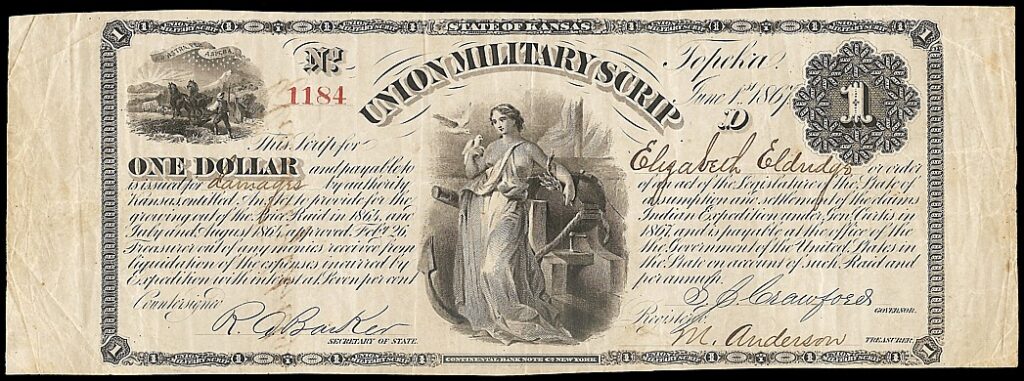
United States (KS Union Military Scrip)1 Dollar - 1867 Front
This issue of the One Dollar Scrip was issued to Elizabeth Eldridge for “damages” incurred from the Price raid. The verbiage of the scrip is virtually the same except for the denomination and serial number. The central vignette is a depiction of Hope standing next to a cannon with a dove, signifying peace, on her hand and another in flight towards her. This particular issue has what is known as selvage, extra portions of the paper it was printed on and normally trimmed off before use.
John Conover, Lieutenant Colonel, 8th Kansas Union Infantry, courtesy of the Missouri Historical Society. The 8th Kansas Cavalry took part in the Price Raid battles.
Judge John F. Phillips, Colonel 7th Missouri Federal Cavalry, commanding Brown’s Brigade of Pleasanton’s Army in the Battle of Westport.
Maj. Gen. James Gillpatrick Blunt, who commanded the Union Army, made up of several units, pursuing, and defeated, Confederate Major-General Sterling Price.
Topeka Kansas in 1867, the city and year these bank notes were issued.